Research
September 10, 2026
Food Costs
Wholesale food prices edged lower in August
Average wholesale food prices registered a modest decline in August, extending restaurant operators’ break from the steady runup in commodity prices that defined the last several years.
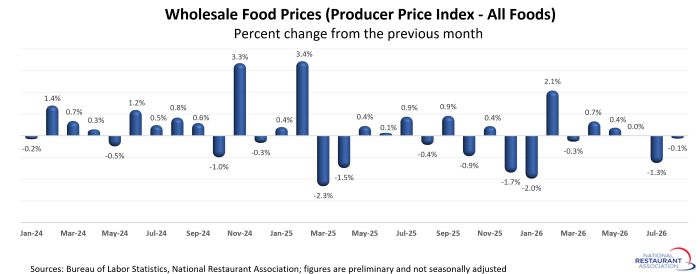
The Producer Price Index for All Foods – which represents the change in average prices paid to domestic producers for their output – edged down 0.1% between July and August, according to preliminary data from the Bureau of Labor Statistics.
The August dip followed a 1.3% drop in July, the largest single-month decline since January (-2.0%).
While the overall price index declined during the last two months, not all commodities followed suit. Producer prices for items such as eggs, fats and oils, confectionery materials, prepared seafood and flour trended higher, making the degree of pricing relief dependent on the menu mix of a given restaurant.
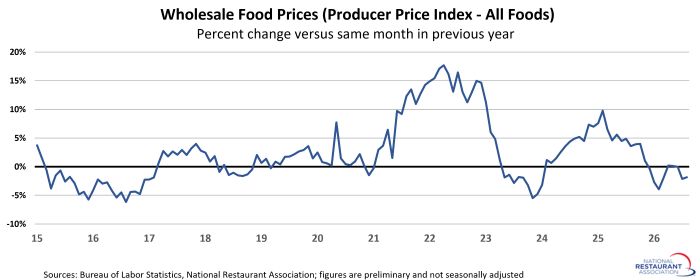
As a result of the recent declines, average wholesale food prices stood 1.9% below their year-ago level in August. That represented the second consecutive month in which the food price index declined on a 12-month basis.
Despite the recent moderation, wholesale food prices remained well above their pre-pandemic levels. As of August 2026, the Producer Price Index for All Foods stood more than 33% above its February 2020 reading.
While the overall food price index declined on a 12-month basis, pricing trends across individual commodities varied significantly.
Producer prices for fats and oils (21.2%), unprocessed finfish (16.3%), prepared seafood (14.8%), fresh fruit (7.6%), wheat flour (5.7%), soft drinks (4.1%), processed fruits and vegetables (4.0%) and beef and veal (3.1%) stood above their August 2025 levels.
In contrast, the price indices for eggs (-59.4%), butter (-38.7%), confectionary materials (-15.7%), pork (-13.9%), processed poultry (-12.5%), fresh vegetables (-10.8%), refined sugar (-10.0%), unprocessed shellfish (-6.5%), milled rice (-4.3%) and cheese (-4.2%) declined from their year-ago levels.
Until wholesale prices start to trend meaningfully lower across a broad range of commodities, food costs will continue to be a headwind for many restaurants.
The Producer Price Index for All Foods – which represents the change in average prices paid to domestic producers for their output – edged down 0.1% between July and August, according to preliminary data from the Bureau of Labor Statistics.
The August dip followed a 1.3% drop in July, the largest single-month decline since January (-2.0%).
While the overall price index declined during the last two months, not all commodities followed suit. Producer prices for items such as eggs, fats and oils, confectionery materials, prepared seafood and flour trended higher, making the degree of pricing relief dependent on the menu mix of a given restaurant.
As a result of the recent declines, average wholesale food prices stood 1.9% below their year-ago level in August. That represented the second consecutive month in which the food price index declined on a 12-month basis.
Despite the recent moderation, wholesale food prices remained well above their pre-pandemic levels. As of August 2026, the Producer Price Index for All Foods stood more than 33% above its February 2020 reading.
While the overall food price index declined on a 12-month basis, pricing trends across individual commodities varied significantly.
Producer prices for fats and oils (21.2%), unprocessed finfish (16.3%), prepared seafood (14.8%), fresh fruit (7.6%), wheat flour (5.7%), soft drinks (4.1%), processed fruits and vegetables (4.0%) and beef and veal (3.1%) stood above their August 2025 levels.
In contrast, the price indices for eggs (-59.4%), butter (-38.7%), confectionary materials (-15.7%), pork (-13.9%), processed poultry (-12.5%), fresh vegetables (-10.8%), refined sugar (-10.0%), unprocessed shellfish (-6.5%), milled rice (-4.3%) and cheese (-4.2%) declined from their year-ago levels.
Until wholesale prices start to trend meaningfully lower across a broad range of commodities, food costs will continue to be a headwind for many restaurants.